


Why Your Academic Transcript Request Matters More Than You Think
An academic transcript request is something millions of people need every year — for job applications, graduate school admissions, professional licensing, or simply replacing a lost record. Here is how to get yours fast:
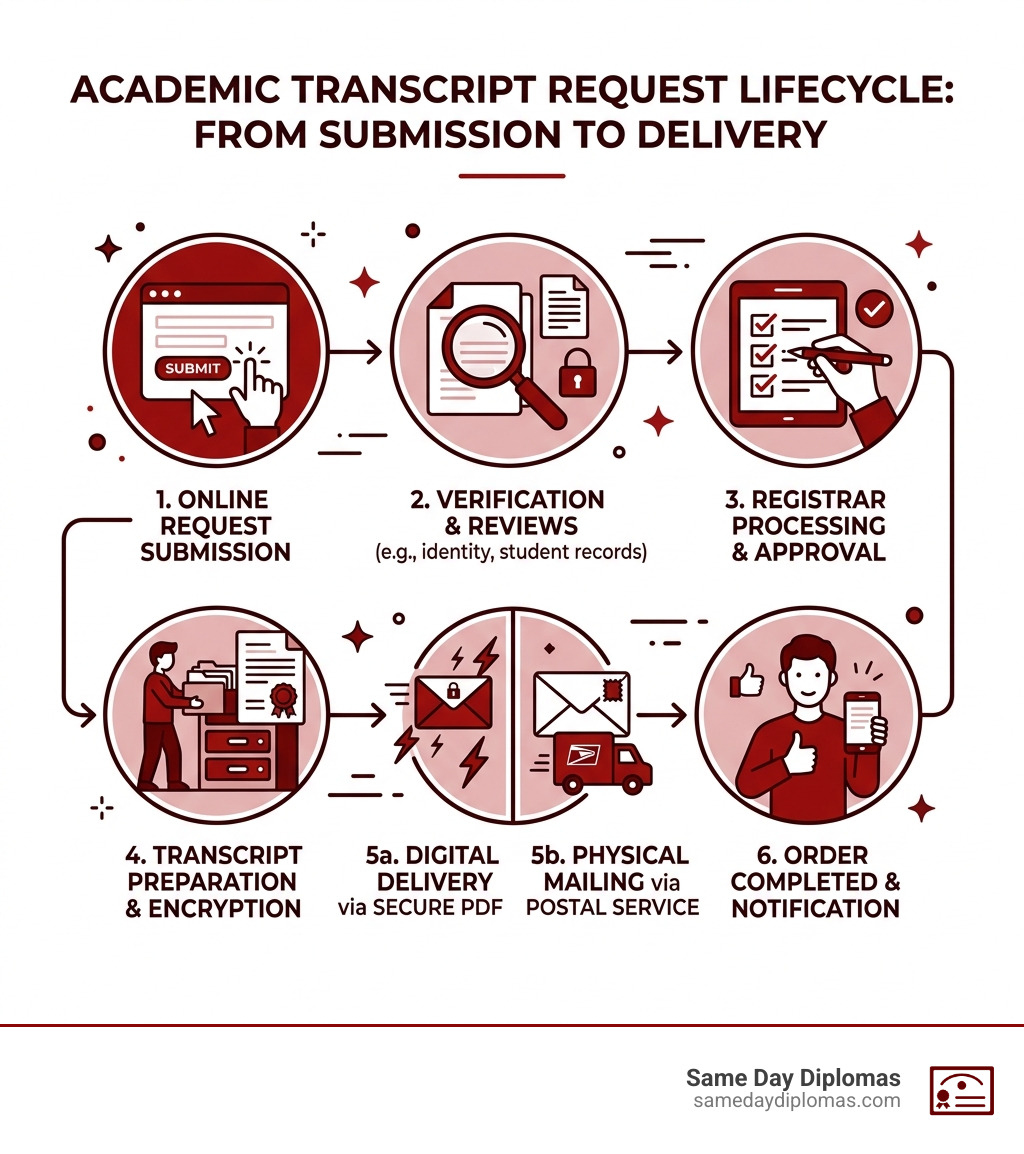
How to request an academic transcript (quick steps):
- Go to your school's registrar website
- Find out if they use Parchment or the National Student Clearinghouse
- Create an account using the exact name from your enrollment records
- Select your delivery method (electronic is fastest)
- Pay the fee (typically $8–$15) and submit
- Track your order — electronic delivery often arrives within 1 business day
The process sounds simple. But for many people, it is anything but. Schools can take anywhere from 2 to 18 business days to process a request. Financial holds, name mismatches, outdated login credentials, and closed institutions can stop your order cold — right when you have a deadline looming.
Over 3.4 million learners earned undergraduate credentials in 2024–25 alone. That is a lot of transcripts in circulation, and a lot of people who need them quickly.
I'm Taylor Pace, founder of Same Day Diplomas, and after 22 years helping people recover and replace lost academic records, I know every roadblock in the academic transcript request process and exactly how to get around them. This guide walks you through everything — from standard requests to closed schools, holds, and urgent situations.
Understanding the Academic Transcript Request Process
Before you hit "submit" on that portal, we need to clarify what you are actually asking for. Not all transcripts are created equal, and sending the wrong one can result in a rejected application.
An official transcript is a legal certified statement of your academic record. It is issued by the registrar and usually features a university seal, a registrar’s signature, and special security paper or digital encryption. If you open a sealed paper transcript or download a secure PDF and then re-upload it yourself, it often loses its "official" status.
| Feature | Official Transcript | Unofficial Transcript |
|---|---|---|
| Issuer | Registrar's Office | Student Portal/Self-Service |
| Security | Sealed envelope or encrypted PDF | Plain paper or web printout |
| Cost | Usually $8 - $15 | Typically Free |
| Primary Use | Employment, Grad School, Licensing | Personal review, Advising |
| Verification | Blue ribbon (digital) or watermark | None |
To dive deeper into the specifics of what these documents contain, check out our essential academic guide on what is on a transcript. Understanding the difference between official and unofficial transcripts is the first step in ensuring your academic transcript request meets the requirements of the person receiving it.
Most institutions follow FERPA (Family Educational Rights and Privacy Act) compliance, which means they cannot release your records without your written or digital consent. Your transcript is a comprehensive history of your time at school, including every course attempted, grades earned, your cumulative GPA, and—most importantly—your degree conferral date.
Why You Need an Official Transcript
You might think your diploma is the "big" document, but in the professional world, the transcript is often the star of the show. There are 10 reasons why you may still need your college transcripts, ranging from background checks to qualifying for a "Good Student" discount on auto insurance.
Common reasons for a request include:
- Employment Verification: Many employers, especially in government, education, or healthcare, require proof of degree and specific coursework.
- Graduate School Admissions: Universities need to see your undergraduate performance before letting you into a Master's or PhD program.
- Professional Licensure: Boards for nursing, teaching, or engineering require official records directly from the source.
- Global Mobility: If you are moving to the UK or Ireland, institutions like the University of London have specific protocols for receiving international records.
Key Information Required for Your Request
To avoid delays, you need to provide pinpoint accurate information. The most common reason for a "pending" status is a data mismatch. You will typically need:
- Full legal name (including your maiden name if it has changed).
- Student ID number or Social Security Number (SSN).
- Date of Birth.
- Attendance dates (even if you can't remember the exact day, the years are vital).
- Current contact information.
If you aren't sure what your record looks like, it’s a good idea to check your high school transcript or college portal first to ensure the data you provide matches what the school has on file.
Navigating Official Channels for Your Academic Transcript Request

The days of walking into a registrar’s office and handing over a check are largely over. Today, the academic transcript request process is handled through massive digital exchange networks. Globally, over 6,100 higher education institutions use these platforms to move records at lightning speed.
In places like the Philippines, there has been a significant digital shift for Transcript of Records, mirroring the systems used in the US, Canada, and Europe. These databases allow for secure, 24/7 ordering.
The Standard Workflow for Online Requests
Most schools don't manage the actual delivery themselves; they partner with a third-party service. The workflow usually looks like this:
- School Search: You visit the registrar's page and follow a link to a portal like Parchment.
- Account Creation: You create a "learner" account. Pro tip: Use a personal email address, not your school email, so you can still access it years after graduation.
- Destination Selection: You choose where the transcript is going. If it’s a common university, the system will have their digital "inbox" ready.
- Delivery Format: You choose between an electronic PDF or a mailed paper copy.
- Tracking: You can monitor the status from "Ordered" to "Processed" to "Delivered."
Electronic transcripts usually have a 30-day download window. If the recipient doesn't download it in time, the link expires, and you'll have to pay for a new one! If you are an alum, learning how to get your high school transcripts often involves these same digital steps.
Understanding National Registries and Databases
If you aren't sure where to start, you can often find your records through a centralized Transcript Ordering Center. The National Student Clearinghouse Transcript Services is a primary hub for thousands of colleges. In other regions, systems like My eQuals Australia provide a similar one-stop shop for digital credentials.
These platforms require a signed consent form, which you can usually sign with your mouse or finger on a smartphone. Once submitted, the system verifies your identity and asks the school to release the record. This 24/7 availability is a lifesaver for last-minute applications, but remember: the platform can only move as fast as your school's registrar. If you're wondering how you get a copy of your college transcripts, these national registries are usually the answer.
Timelines, Costs, and Delivery Methods

When you make an academic transcript request, you are paying for two things: the record itself and the speed of delivery.
- Electronic Delivery: This is the gold standard in May 2026. It typically costs $8 to $10 and is often delivered within 24 hours of school approval.
- USPS Standard Mail: Usually the cheapest option (sometimes even free at schools like UCLA), but it can take 7–10 business days to arrive.
- FedEx/UPS Overnight: If you need a physical copy tomorrow, expect to pay a premium. Domestic overnight shipping usually starts around $35, while international shipping can soar to $65 or more.
It is important to remember that high school and college replacement transcripts have different fee structures depending on whether you are ordering an official copy for a third party or a copy for your own records.
Factors Affecting Processing Speed
While technology has improved response times by up to 99% in some districts (moving from 20 days to same-day processing), humans are still involved.
- Peak Periods: From May to June (graduation season) and August to October (application season), registrars are swamped. Expect delays.
- Validation: The school must manually "validate" that you don't owe money and that your records are accurate.
- Legacy Records: If you attended school before 1982, your records might be on microfilm or paper, requiring 4–5 extra business days for digitization.
Institutions like Trinity College Dublin warn students that during peak times, processing can slow down significantly. If you've lost your school transcripts and need a copy fast, always opt for the electronic version.
Handling an Academic Transcript Request for Closed Schools
What happens if your school no longer exists? This is a common hurdle, but your records aren't gone forever. When a school closes, they are legally required to transfer their records to a state repository or a "successor" institution.
For example, in Canada, you can order transcripts and certificates through the Province of British Columbia for many closed K-12 schools. In the US, the Division of Private Occupational Schools (DPOS) or the State Department of Higher Education usually acts as the custodian. We have a detailed guide on what to do when you need a replacement of your transcripts from a defunct institution. Often, these records are eventually moved to Parchment for easier fulfillment, even if the school's physical doors are shut.
Overcoming Common Obstacles in Your Transcript Request
Nothing is more frustrating than seeing a "Hold" icon on your academic transcript request. It usually means the process has stopped until you take action.
Troubleshooting Name Mismatches and Account Holds
- Financial Holds: This is the #1 obstacle. If you owe tuition, library fines, or even a parking ticket, many schools will legally withhold your official transcript. If you're in this boat, see our advice on how to get a copy of your college transcripts if you owe money.
- Name Mismatches: If you applied as "Jane Smith" but your record says "Jane Doe," the system won't find you. Always use the name you used while enrolled.
- Missing Signatures: Even in 2026, some schools require a "wet" signature or a specific PDF upload of a consent form.
If you are facing "transcript troubles," you might consider buying a high school transcript for college applications as a backup or for personal reference while you sort out the official mess. For students in Puerto Rico, the Online Transcript portal provides specific localized support for these issues.
International and Specialized Requests
If you are sending transcripts across borders, the complexity increases.
- Notarization and Apostille: Many foreign employers or governments require your transcript to be notarized and then given an Apostille (a form of international authentication). This is only possible with paper transcripts.
- Evaluation Services: If you studied in France at an institution like ACM France, you might need a service like WES (World Education Services) to "translate" your grades into a US or Canadian GPA.
- Shipping: For international delivery, we highly recommend using DHL Express. It provides tracking that standard mail simply can't match.
Understanding the parts of a college and high school transcript is vital here, as international receivers often look for very specific credit breakdowns.
Frequently Asked Questions about Transcript Requests
How long does it take to receive an electronic transcript?
Typically, once the school approves the request, it is delivered within 1 to 3 business days. Many schools now offer "near-instant" delivery that can happen within 4 hours if there are no holds on your account.
Can I order a transcript for someone else?
Generally, no. Due to FERPA and privacy laws, only the student can authorize the release of their records. However, third parties (like employers) can request a transcript if they upload a signed consent form from the learner.
What is the difference between a transcript and a diploma?
A diploma is a ceremonial document that confirms you graduated. A transcript is a detailed "academic roadmap" that shows every class you took, every grade you earned, and your final GPA. For most professional and educational purposes, the transcript is the required document.
Conclusion
Navigating an academic transcript request doesn't have to be a headache. By understanding the difference between official and unofficial records, knowing which platform your school uses, and preparing for common hurdles like financial holds, you can get your credentials exactly when you need them.
At Same Day Diplomas, we understand that sometimes the official channels are too slow or your original documents have been lost to time, fire, or moves. We provide high-quality replacement services for lost or damaged records, offering professional templates and fast turnaround times to help you keep your career on track. Whether you need a realistic replacement for display or a personal reference copy to help fill out complex applications, we are here to help.
For more tips on managing your academic history, visit our full blog for the latest guides and industry insights.


