


Why a Bachelor of Science in Chemistry Opens More Doors Than You Think
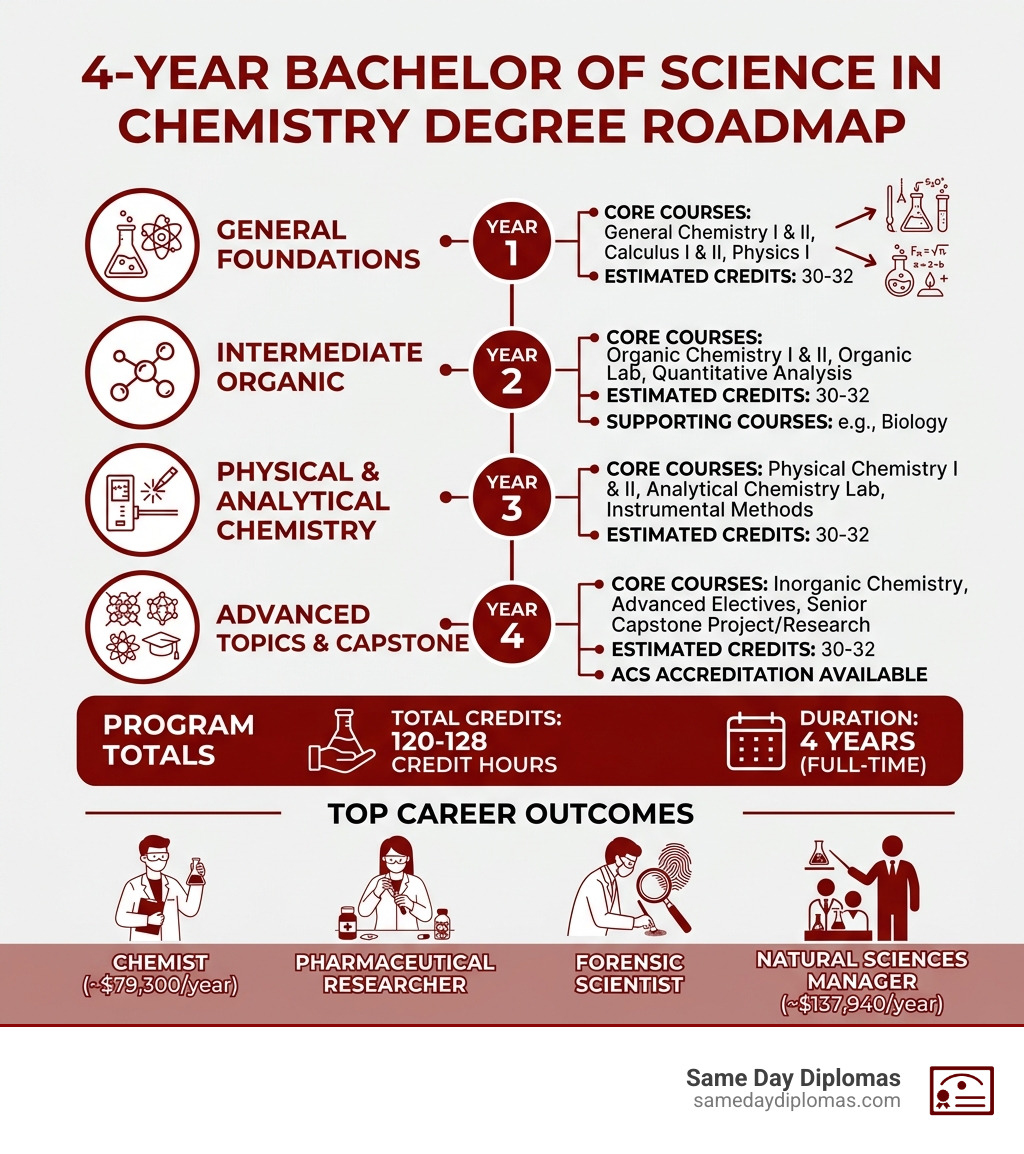
A bachelor of science in chemistry is one of the most versatile and rigorous undergraduate degrees you can earn. Here's a quick snapshot of what it covers and where it leads:
Quick Facts: B.S. in Chemistry
| Topic | Key Detail |
|---|---|
| Total credits | 120–128 credit hours |
| Program length | 4 years (full-time) |
| Core subjects | Organic, physical, analytical, inorganic chemistry |
| Supporting courses | Calculus, physics, biology |
| ACS accreditation | Available at many universities |
| Top career paths | Chemist, pharmaceutical researcher, forensic scientist |
| Median chemist salary | ~$79,300/year |
| Highest-earning role | Natural sciences manager (~$137,940/year) |
Chemistry is known as the central science — it sits at the intersection of biology, physics, medicine, and materials. A B.S. in chemistry prepares you for professional lab work, graduate school, medicine, pharmaceuticals, environmental science, and much more.
This guide walks you through everything: degree requirements, specializations, career outcomes, salary data, and how programs compare across universities.
I'm Taylor Pace, founder of Same Day Diplomas, and over 22 years of working with thousands of chemistry and STEM graduates — helping them restore and replace their bachelor of science in chemistry credentials — I've developed a deep understanding of what these programs look like on paper and what they mean professionally. Let's dig into what this degree actually involves, so you can plan your path with confidence.
Defining the Bachelor of Science in Chemistry: Curriculum and Core Outcomes
At its heart, a bachelor of science in chemistry is the scientific study of the composition, properties, and transformations of matter. As we move into May 2026, the demand for professionals who can navigate complex molecular structures and interpret data is higher than ever. Unlike more general science degrees, the B.S. track is designed to be intensive and comprehensive, focusing heavily on quantitative analysis and scientific inquiry.
Students in these programs don't just memorize the periodic table; they learn how to manipulate matter. Through rigorous coursework, you gain proficiency in molecular synthesis, characterization, and the use of advanced instrumentation like NMR (Nuclear Magnetic Resonance) and HPLC (High-Performance Liquid Chromatography).
One of the most critical outcomes of this program is the development of data ethics. When scientific integrity is paramount, chemistry programs emphasize the honest reporting of data and the social responsibility of transforming matter. According to the Bachelor of Science Degree in Chemistry - Chemistry, programs often focus on "cross-cutting concepts" like chemical causality and the benefits versus risks of chemical processes.

Core Coursework: From Organic to Physical Bachelor of Science in Chemistry
The curriculum for a bachelor of science in chemistry is built on five traditional subdisciplines. Most universities follow a structured sequence that starts with General Chemistry and moves into specialized territory:
- General Chemistry: The foundation, covering atomic structure, bonding, and stoichiometry.
- Organic Chemistry: Often the "make or break" sequence for majors, focusing on carbon-based compounds and synthesis.
- Analytical Chemistry: The art of measurement. You’ll learn how to identify what is in a substance and how much of it exists.
- Physical Chemistry: This is where chemistry meets physics. It involves thermodynamics, quantum mechanics, and kinetics.
- Inorganic Chemistry: The study of non-carbon compounds, including metals and organometallics.
As noted in the Chemistry Major (B.S.) | University of New Hampshire Academic Catalog, students are expected to construct meaning at both the particulate and macroscopic levels, bridging the gap between what happens in a test tube and the laws of physics that govern those reactions.
Supporting Sciences: The Role of Math and Physics
You cannot be a chemist without being a part-time mathematician and physicist. The bachelor of science in chemistry requires a significant amount of "allied" or supporting coursework. Most programs, such as the one at Binghamton University, require:
- Calculus I & II: Essential for understanding rates of reaction.
- Multivariate Calculus & Differential Equations: Often required for Physical Chemistry.
- General Physics (Calculus-based): Usually a two-semester sequence with labs.
- Biological Sciences: Particularly if you are pursuing a biochemistry concentration.
This heavy math and physics load is often what distinguishes the B.S. from other degrees, providing the technical depth needed for high-level industry roles.
BS vs. BA in Chemistry: Choosing the Right Path for Your Career
One of the most frequent questions we hear at Same Day Diplomas is whether a student should pursue a Bachelor of Science (B.S.) or a Bachelor of Arts (B.A.). The choice depends entirely on your end goal.
| Feature | Bachelor of Science (B.S.) | Bachelor of Arts (B.A.) |
|---|---|---|
| Course Depth | Intensive; more upper-division labs | Broader; fewer advanced chemistry units |
| Math/Physics | Heavy (Multivariate Calc, Physics III) | Standard (Calculus I, General Physics) |
| Flexibility | Lower; highly structured | Higher; room for a second major or minor |
| Best For | Chemical Industry, Ph.D. Programs | Med School, Law, Teaching, Sales |
As the Ball State University catalog highlights, the B.A. offers flexibility for students who want a strong science background but may want to work in patent law or healthcare administration. The B.S., however, is the "gold standard" for those who want to be called a "Professional Chemist."
The Value of an ACS-Certified Bachelor of Science in Chemistry
If you want your degree to carry maximum weight, look for a program certified by the American Chemical Society (ACS). An ACS-certified bachelor of science in chemistry means the department meets the stringent standards of the ACS Committee on Professional Training (ACS-CPT).
According to UNLV’s program description, ACS certification ensures you have had sufficient "hands-on" time with modern instrumentation. For an employer in 2026, an ACS-certified degree is a benchmark of quality, proving that you’ve completed advanced coursework in instrumental analysis and inorganic chemistry that a standard degree might lack.
Specializations and Hands-On Experience
While the core of chemistry is universal, many students choose to specialize. Concentrations allow you to tailor your bachelor of science in chemistry to a specific industry. Common paths include:
- Biochemistry: Focusing on the chemical processes within living organisms.
- Forensic Chemistry: Applying chemical principles to legal investigations.
- Pharmaceutical Chemistry: The science of drug design and development.
- Materials Chemistry: Studying the application of chemistry to materials discovery and characterization.
Programs like those at Kennesaw State University even offer "Integrative" tracks or "Pharmaceutical" concentrations to give students a head start in specific job markets.
Undergraduate Research and Capstone Projects
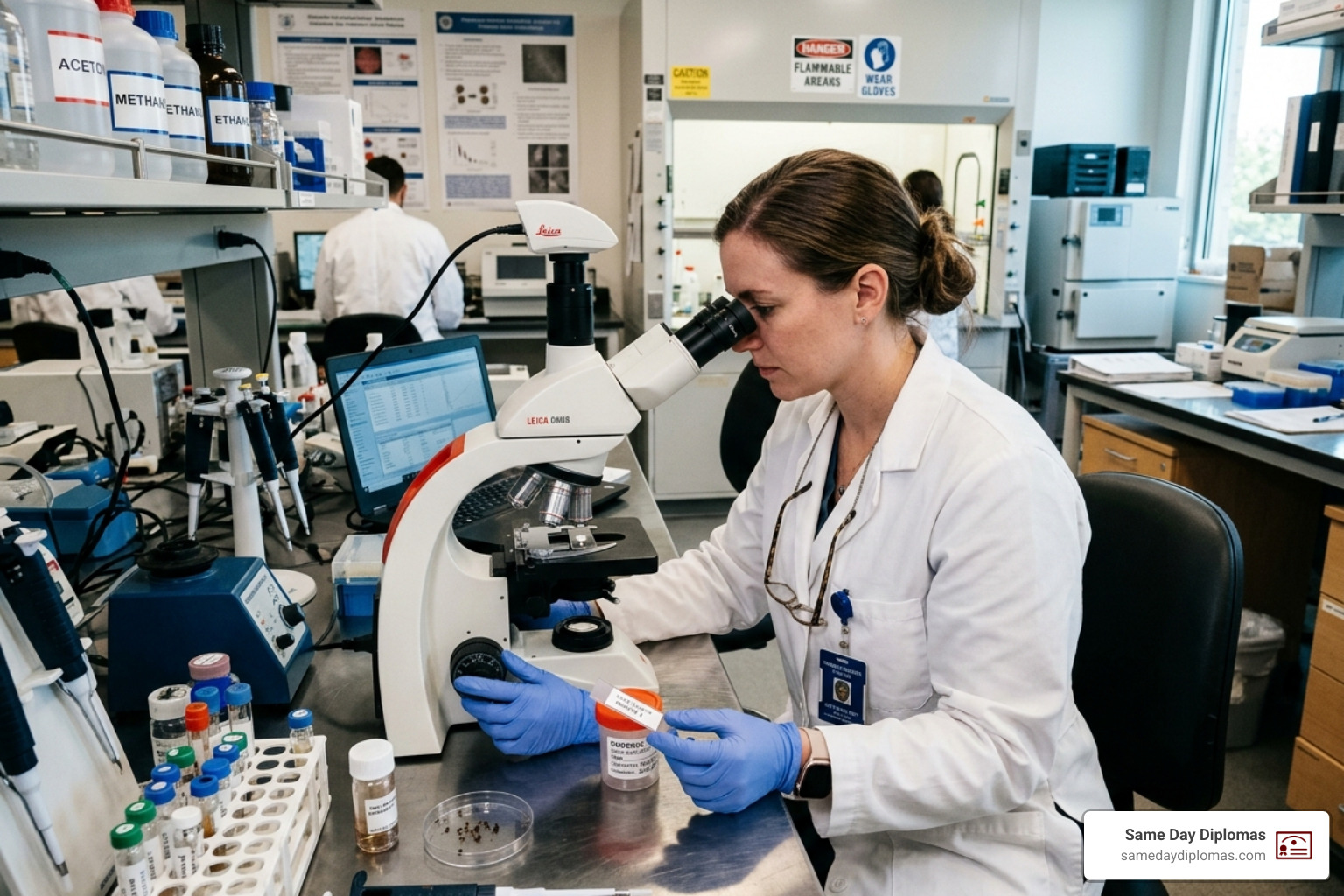
In a chemistry program, the lab is your second home. Most B.S. programs require a capstone experience or senior research project. This isn't just another class; it’s an opportunity to work one-on-one with faculty mentors on original scientific problems.
Engaging in research is often the single most important factor for graduate school admissions. It teaches you how to troubleshoot equipment, design experiments, and present your findings—skills that a textbook simply cannot provide. For those looking ahead to advanced degrees, understanding the rigor of research is vital, as we discuss in our guide on buying a realistic looking PhD degree online for display and commemorative purposes.
Career Outlook: Salaries and Job Opportunities for Graduates
Is a bachelor of science in chemistry worth the effort? The data says yes. In 2026, chemistry remains a vital sector in the global economy. Graduates are qualified for a diverse range of roles, from environmental analysis to cosmetics and food science.
According to stats from Kent State University, the median yearly wage for chemists is approximately $79,300. However, the ceiling is much higher:
- Natural Sciences Managers: Median earnings of $137,940.
- Forensic Science Technicians: Growing at a rate of 14.1%, much faster than average.
- Food Scientists: Median earnings of $73,450.
Industry Roles and Graduate School Pathways
While many graduates head straight into quality control or toxicologist roles, a B.S. is also the perfect "stepping stone." Many of our clients at Same Day Diplomas use their replica bachelor degrees to display their undergraduate achievements while they pursue a Ph.D. or medical degree.
Industry roles are plentiful in:
- Petrochemicals and Mining
- Pharmaceuticals and Biotech
- Environmental Consulting (which often requires state licensure)
- Water Quality and Public Safety
If you're considering the long-term path, a Ph.D. is often required for leadership roles in research and development, while a B.S. is excellent for entering the workforce as a high-level technician or analyst. For more on the value of these credentials, check out our insights on buying a real US degree for your personal records.
Navigating the Timeline: Credits, Prerequisites, and Admission
Earning a bachelor of science in chemistry typically requires between 120 and 128 credit hours. While the "standard" timeline is four years, the reality can be different. Chemistry has a "domino effect"—because courses like Organic Chemistry II require Organic Chemistry I, and both require General Chemistry, missing one semester can delay graduation by a full year.
Typical Admission and Graduation Requirements:
- GPA: Most programs require a minimum 2.0 to 2.5 GPA in the major.
- Minimum Grades: Many schools, like Sacramento State, require a "C-" or better in all major courses.
- Residency: You usually must complete at least 30–32 credits at the institution granting the degree.
- Math Readiness: If you aren't ready for Calculus I on day one, you may need an extra semester to catch up on prerequisites.
At Same Day Diplomas, we understand the hard work that goes into these four years. Whether you are replacing a lost document or need a display copy for your office, our bachelor degree templates are designed to reflect the specific formatting and technical notations (like laboratory credits) that make a chemistry degree unique.
Frequently Asked Questions about a Chemistry Degree
How long does it take to complete a Bachelor of Science in Chemistry?
For most full-time students, it takes 4 years. However, due to heavy lab hours (sometimes 15+ hours a week in the lab) and strict math prerequisites, some students take 4.5 to 5 years. Part-time students may take 6 to 8 years.
Can I get a chemistry degree online?
Purely online bachelor of science in chemistry degrees are extremely rare and often not ACS-certified. This is because chemistry is a "hands-on" science that requires physical presence in a laboratory to master instrumentation and safety protocols. Some "hybrid" programs exist, but they still require in-person lab intensives.
What is the average salary for a chemistry graduate in 2026?
As of May 2026, the average starting salary for a chemistry graduate with a B.S. is between $50,000 and $65,000, while the median for all chemists is approximately $79,300. Those who move into management roles can earn well over $130,000.
Conclusion
The journey from wearing a lab coat in a university basement to collecting a paycheck in a high-tech facility is a challenging but rewarding one. A bachelor of science in chemistry is more than just a piece of paper; it’s a testament to your ability to solve complex problems, handle dangerous materials safely, and analyze the world at a molecular level.
Whether you are a current student planning your 4-year roadmap or a graduate looking to showcase your academic heritage, your credentials matter. At Same Day Diplomas, we take pride in helping professionals maintain their academic records with high-quality replacements and replicas. From replica bachelor degrees to detailed transcripts, we ensure your hard work is represented with the quality it deserves.
Ready to learn more about restoring your academic documents or exploring degree replacement services? Check out our blog for more information on how we support STEM professionals across the globe.


