


Essential Components of an Academic Transcript Request Form
An academic transcript request form is the official document you submit to your school's registrar to authorize the release of your academic records. Here's a quick overview of what you need to know:
To request an academic transcript, you typically need to:
- Find your school's registrar or records office (or their third-party provider like Parchment or National Student Clearinghouse)
- Complete the transcript request form — online, by mail, or in person
- Provide a valid photo ID and your student ID or date of birth
- Pay any applicable processing fees
- Choose your delivery method (electronic or paper) and provide recipient details
- Sign the form (handwritten — typed signatures are not accepted under FERPA)
Processing times range from 2–48 hours for electronic requests to 3–5 business days (or longer during peak periods) for standard mail.
Getting any one of these steps wrong can delay your transcript — sometimes at the worst possible moment, like right before a job application deadline.
I'm Taylor Pace, founder of Same Day Diplomas, and over the past 22 years I've helped tens of thousands of people navigate the frustrating gap between needing an academic transcript request form processed and actually getting their documents in hand. That experience gives me a front-row seat to exactly where the process breaks down — and how to move faster when it counts.
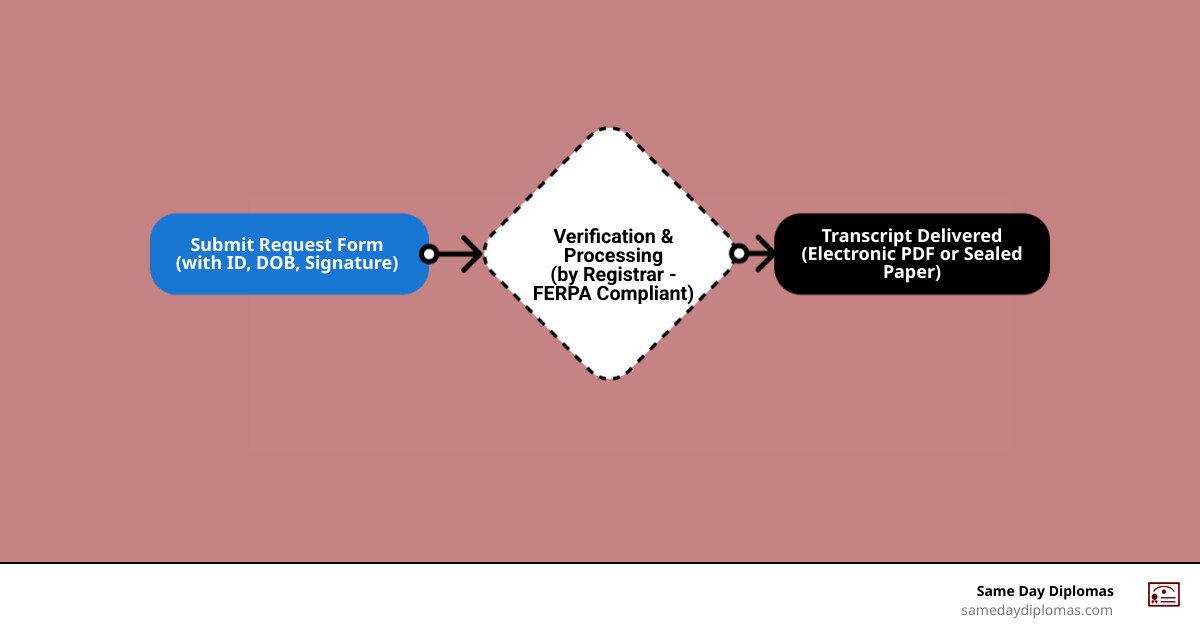
When you sit down to fill out an academic transcript request form, you aren't just filling out a questionnaire; you are completing a legal authorization. Because of the Family Educational Rights and Privacy Act (FERPA) of 1974, schools cannot simply hand over your grades to anyone who asks. They need to verify that you are who you say you are and that you have explicitly given them permission to share your data.

Most forms, such as the Official Transcript Request | University Registrar Services provided by major universities, require specific "identifiers" to pull your file from the archives. These typically include:
- Full Legal Name: This includes any "former names" or maiden names you used while attending. If you attended as "Jane Smith" but are now "Jane Doe," the system might not find you without both.
- Student ID Number or Social Security Number: While many schools are moving away from SSNs for privacy, they are often the most reliable way to find records for students who attended decades ago.
- Date of Birth: A secondary verification to ensure they don't send the records of the other John Smith who graduated the same year.
- Dates of Attendance: You don’t need the exact day, but the years are crucial for locating physical files or microfilm.
- Degree Conferral: Did you actually graduate, or just attend? If you need the transcript to show your degree, you must specify this.
- Handwritten Signature: This is the most common reason forms are rejected. Under FERPA, a typed name is usually not sufficient. You must provide a "wet" signature or a verified digital signature that meets the institution's legal standards.
Understanding The Parts Of A College And High School Transcript can help you ensure the form you’re filling out will actually result in the document you need.
Required Documentation and Fees
Don't expect the school to take your word for it. To prevent identity theft and academic fraud, most registrars require a copy of a valid government-issued photo ID (like a driver's license or passport) to be submitted alongside the academic transcript request form.
Then, there’s the cost. While some community colleges offer a few free copies to current students, most institutions charge a fee. For example, Academic Transcript Order Form | Student Administration at the University of Edinburgh or similar forms at Texas A&M ($10 per copy) or Stony Brook ($30 for same-day service) show the range of pricing you might encounter.
Fees usually cover:
- Standard Processing: The administrative time to verify and print the record.
- Expedited Shipping: If you need a physical copy sent via FedEx or UPS instead of standard mail, expect to pay $20–$45 extra.
- Digital Convenience Fees: Third-party platforms like Parchment often add a small service fee for the security of electronic delivery.
For a deeper dive into the logistics, check out our guide on How Do You Get A Copy Of Your College Transcripts.
Delivery Methods and Recipient Information
How the transcript is delivered determines whether it is considered "official." An official transcript is only official if it remains in the custody of the school or a trusted third party until it reaches the recipient.
- Electronic PDF: The fastest method. Services like the National Student Clearinghouse Transcript Services deliver a secure link to the recipient. Note: These often become "unofficial" the moment you download or print them yourself.
- Sealed Envelopes: If you choose mail delivery, the transcript is placed in a signed, stamped, and sealed envelope. If you open it, it's no longer official.
- Direct-to-Institution: Many schools prefer to send transcripts directly to other admissions offices via secure networks like SPEEDE.
It is vital to understand Whats The Difference Between Official And Unofficial Transcripts before you pay. If you just need to see your grades for a resume, an unofficial copy is fine. If you’re applying to med school, only the official version will do.
How to Submit Your Academic Transcript Request Form
The method you choose to submit your academic transcript request form usually depends on when you attended. Most modern students can use an online portal, while alumni from the 1980s or earlier might be reaching for a stamp and envelope.
| Method | Speed | Best For... |
|---|---|---|
| Online Portal | Instant to 48 Hours | Recent graduates and current students. |
| Third-Party (Parchment/NSC) | 1-3 Business Days | Most major universities and many high schools. |
| Mail-In Form | 1-3 Weeks | Older records, manual archives, or closed schools. |
| In-Person | Same Day (sometimes) | Urgent needs (if you live near the campus). |
Many schools, like those using the Welcome to Online Transcript portal for the University of Puerto Rico, have streamlined the process entirely. However, if you are looking for secondary school records, the process can vary wildly. You might need to call the district office directly, which we explain in our guide on How To Get Your High School Transcripts.
Filling Out the Academic Transcript Request Form for Closed Schools
What happens if your school is no longer there? This is a common nightmare for students of independent career colleges or vocational schools. In Florida, the Commission for Independent Education handles records for closed independent postsecondary schools. In Texas, the Texas Higher Education Coordinating Board (THECB) often points students toward services like Diploma Sender to find their "custodian of records."
If your school has shuttered, you cannot simply call a registrar. You must find the state-designated agency that holds the archives. These transcripts are provided "as received," meaning they cannot be edited or updated. If you find yourself in this situation, our resource on What To Do When You Need A Replacement Of Your Transcripts can be a lifesaver.
Handling Legacy Records and Pre-2001 Dates
If you attended school before the digital revolution (generally pre-2001 for many institutions, or even earlier for some), your records might not be in a searchable database. They may be stored on microfilm or in manual paper archives in a "system office."
When filling out an academic transcript request form for legacy records, allow for "extended processing." It can take up to three weeks for a staff member to physically locate, scan, and verify an old record. If you are in this demographic, check out High School And College Replacement Transcripts for tips on navigating older systems.
Overcoming Common Obstacles and Delays
Nothing stops a transcript request faster than a "Hold" notification. This is the "Check Engine" light of the academic world.

Financial Holds and Tuition Debt
The most common obstacle is the financial hold. If you owe the school money—whether it’s $5,000 in tuition or $5.00 in library fines—they can legally refuse to release your official transcript. While some regions are passing laws to limit this practice (especially for employment purposes), it remains a significant barrier.
If you’re stuck, read our guide: How To Get A Copy Of Your College Transcripts If You Owe Money. Sometimes, schools will release an unofficial copy or allow a 30-day window if you can prove the transcript is needed for a job that will help you pay off the debt.
Troubleshooting Your Academic Transcript Request Form Submission
Even if your record is clean, other factors can cause delays:
- Peak Periods: During graduation season (May/June) or the start of a semester, registrar offices are swamped. A 48-hour turnaround can easily turn into two weeks.
- Incorrect Recipient Info: A single typo in an email address for a digital transcript means the "official" link goes nowhere.
- Name Mismatches: If your form says "Robert" but the school record says "Bob," the automated system might kick it back for manual review.
For more on what might be gumming up the works, see What Can Prevent You From Getting Your Transcripts.
Tracking and Verifying Your Request Status
Once you hit submit, don't just hope for the best. Most modern services provide an order number and real-time tracking. If you used the National Student Clearinghouse Transcript Services, you can log in to a dashboard to see exactly when the school "pulled" the request and when the recipient "opened" the file.
If you are tracking a high school record, you might have to be a bit more proactive with follow-up calls to the guidance office. We’ve outlined the steps for this in How To Check Your High School Transcript.
Frequently Asked Questions about Transcript Requests
How long does it take to process an academic transcript request form?
Typically, electronic requests are processed within 24–48 hours, and recipients receive them within 4 hours of processing. Paper transcripts usually take 3–5 business days to process, plus the time for USPS or international mail. If you need it faster, check out Lost Your School Transcripts Heres How To Get A Copy Fast.
Can I request a transcript if I have a financial hold?
In most cases, no. Official transcripts are withheld until the balance is cleared. However, some registrar policies allow for a temporary release for specific reasons, or they may provide an unofficial copy. Learn more about How To Get A Copy Of Your College Transcripts If You Owe Money.
What is the difference between official and unofficial transcripts?
Official transcripts have the registrar's seal, special watermarks, and are sent directly to the recipient. Unofficial transcripts are usually just a printout of your "academic history" for personal reference. For a full breakdown, see Diploma And Transcript What Are The Key Differences.
Conclusion
Navigating an academic transcript request form can feel like a test you didn't study for, but with the right checklist, it’s a hurdle you can easily clear. Whether you are transferring schools, applying for a dream job, or just trying to keep your records organized, getting these documents right is essential for your professional future.
At Same Day Diplomas, we understand that sometimes the official channels are too slow, or you simply need a high-quality replacement for a lost document to display in your office. We specialize in fast, professional craftsmanship, offering realistic and customizable replacement documents that help you bridge the gap when you need them most.
Ready to secure your academic history? Get your replacement academic documents today and let us help you put your best foot forward.


