


An associate of arts degree opens doors. Whether you’re looking to start a career, transfer to a four year university, or simply build foundational skills, the AA degree offers a practical and affordable pathway. This guide breaks down everything you need to know about earning an arts degree, from credit requirements to career options and transfer strategies. This guide is for prospective students, parents, and career changers considering an Associate of Arts degree. Understanding the AA degree helps you make informed decisions about your education and career path.
Key Takeaways
-
An Associate of Arts (AA) degree is a two year degree requiring approximately 60 credits, focused on liberal arts, humanities, and social sciences through general education coursework.
-
Many AA programs function as transfer pathways, allowing students to enter bachelor’s programs at junior (third-year) standing when courses align with university requirements.
-
Typical costs at U.S. community colleges in 2024–2026 range from $3,000–$4,500 per year for in-district tuition before financial aid, making it one of the most affordable higher education options.
-
Common outcomes include entry level jobs in business support, social services, and creative arts, plus the option to continue toward a bachelor’s degree.
-
Same Day Diplomas creates realistic novelty AA diploma and transcript replicas for display or prop use—these are not official academic credentials and cannot be used for verification purposes.
What Is an Associate of Arts (AA) Degree?
An associate of arts degree is an undergraduate credential typically completed in two years of full-time study at community colleges or some universities. The aa degree requires about 60 semester credits, covering broad general education in English, communication, mathematics, social sciences, humanities, and fine arts rather than intensive lab science or engineering coursework.
Most AA curricula mirror the first two years of a typical bachelor’s degree program, making them intentionally transfer-friendly. This design allows students to complete foundational courses locally before moving to a university for their remaining credits.
In 2024–2026, students can pursue AA degrees through multiple delivery formats:
-
In-person classes at local colleges
-
Hybrid programs combining online and campus sessions
-
Fully online aa programs from accredited institutions
Real institutions offering AA degrees include Miami Dade College, Santa Monica College, and Johnson County Community College. Before enrolling, verify that your chosen program holds regional or national accreditation—this matters significantly if you plan to transfer credits later.
Unlike vocational certificates that focus narrowly on specific job skills, an associate degree provides broader academic preparation applicable across many fields, and understanding what an associate degree is and how it can benefit your career can help you decide if this path fits your goals.

Program Length, Credit Hours, and Typical Courses
An Associate of Arts (AA) degree typically requires 60 credit hours to complete, which usually translates to about 20 courses over a two-year period. This structure assumes full-time enrollment of 15 credits per semester.
Variations exist based on enrollment status:
|
Enrollment Type |
Typical Completion Time |
|---|---|
|
Full-time (15 credits/semester) |
2 years |
|
Part-time (6-9 credits/semester) |
3-4 years |
|
Accelerated online |
18 months or less |
|
A typical AA plan breaks down as follows: |
|
-
General education courses (36-40 credits): English composition, public speaking, college algebra or statistics, history, psychology, and a physical science or lab science course
-
Electives and major-specific courses (20-24 credits): Courses aligned with your intended focus area
General Education typically includes English composition, history, behavioral sciences, and introductory math or social sciences. Concrete course examples include:
-
English Composition I
-
Introduction to Sociology
-
U.S. History since 1877
-
Public Speaking
-
Art Appreciation
Electives allow students to explore interests or fulfill prerequisites for their intended major, such as literature, philosophy, or fine arts. To earn an AA degree, students must typically maintain a minimum grade point average of 2.0 and complete a specified number of credit hours in general education and electives, which may vary by institution.
Many colleges accept Advanced Placement (AP), International Baccalaureate (IB), CLEP tests, or prior college credits to reduce courses required for completion. Some programs also incorporate internships, service learning, or capstone seminars as optional components.
What Can You Study in an Associate of Arts Degree Program?
Common Fields of Study
AA degree programs span liberal arts, humanities, social sciences, and certain business and creative fields. Associate of Arts degree programs typically include a variety of fields of study such as psychology, business, music, and communication.
Common areas of study within an Associate of Arts degree include:
|
Category |
Common Majors |
|---|---|
|
Social Sciences |
Psychology, Criminal Justice, Sociology |
|
Business |
Administration, Accounting, Marketing |
|
Humanities & Arts |
Communication, Education, Journalism, Studio Art |
|
General Studies |
Liberal Arts, Interdisciplinary Studies |
Customizing Your AA Program
Students pursuing an Associate of Arts degree can tailor their education by selecting from general education courses, subject-specific courses, and electives to align with their interests and career goals. AA degree programs generally include a combination of general education courses, subject-specific courses, and electives, allowing students to customize their path.
Those planning to transfer should align their AA major with their intended bachelor’s major. Many institutions publish sample guided pathways mapping AA coursework to specific transfer universities and majors.

AA in Liberal Arts
The AA in Liberal Arts represents a broad, flexible arts degree program covering humanities, social sciences, math, natural sciences, and sometimes basic business courses. This track maximizes transfer flexibility into a wide range of bachelor’s programs.
At Johnson County Community College, for example, the Associate of Arts requires 60 credits including Kansas Systemwide General Education requirements and electives. Key skill outcomes include:
-
Academic writing and research literacy
-
Data interpretation and quantitative reasoning
-
Intercultural awareness
-
Oral communication
-
Critical thinking across disciplines
Liberal arts AA graduates pursue entry level positions as administrative assistants, customer service representatives, sales associates, or support roles in education and nonprofits. Many transfer into bachelor’s degrees in English, history, sociology, communications, or education to expand their career options.
AA in Digital Photography and Creative Arts
An AA in Digital Photography or similar creative fields blends general education with technical courses on camera operation, lighting, composition, and image editing software. Common course topics include:
-
Design theory and visual composition
-
Adobe Photoshop and Lightroom proficiency
-
Studio photography techniques
-
Portfolio development
-
Small business basics for freelancers
Students build professional portfolios to pursue entry-level roles such as assistant photographer, photo editor, or content creator. Electives may allow focus on niches like wedding photography, commercial product work, or social-media-ready visual content.
Some graduates transfer into BFA (Bachelor of Fine Arts) or BA in Art/Photography programs for further specialization in the creative arts.
AA vs. AS vs. AAS: Key Differences
The three main U.S. associate degree types serve different purposes:
|
Degree Type |
Focus |
Best For |
|---|---|---|
|
AA (Associate of Arts) |
Liberal arts, humanities, social sciences |
Transfer to BA/BS programs |
|
AS (Associate of Science) |
Math, science, technology |
Transfer to STEM bachelor’s programs |
|
AAS (Associate of Applied Science) |
Career-specific technical training |
Direct workforce entry |
|
An Associate of Arts (AA) degree typically focuses on liberal arts education, including social sciences, humanities, and design, while an Associate of Science (AS) degree emphasizes business, technology, or practical sciences. The AA degree generally requires 60 credit hours to complete, which is similar to other associate degrees, but the coursework is more focused on liberal arts compared to the AS degree’s emphasis on science and technical subjects. |
|
|
|
While both AA and AS degrees are two-year programs, the AA degree is often seen as a stepping stone for students who may want to pursue a bachelor’s degree in liberal arts or related fields, whereas the AS degree is more geared towards immediate employment in technical fields. |
|
|
Example scenario: A student interested in media might choose an AA in Communications for transfer to a journalism program. A student targeting software development might select an AS in Computer Science with calculus and physics prerequisites. Someone wanting immediate employment in IT support might pursue an AAS in Network Administration focusing on certifications.
What Is an Associate of Arts Degree Used For?
An associate in arts degree serves two primary purposes: qualifying for certain entry level jobs and acting as the first half of a four year university degree.
Many employers in fields like customer service, sales, office administration, and public service list “associate degree preferred or required” in job postings. Earning an Associate of Arts degree can increase your marketability and job candidacy, as many jobs today require an associate degree.
According to the U.S. Bureau of Labor Statistics, jobs requiring at least an associate degree are expected to rise 8.8% from 2021 to 2031, highlighting growing demand for this education level in the workforce.
Personal benefits extend beyond employment:
-
Increased confidence in professional settings
-
Improved communication and writing skills
-
Exposure to new disciplines that influence long-term career goals
-
Satisfaction of employer tuition reimbursement or promotion requirements
What Jobs Can You Get With an Associate of Arts Degree?
Job options depend on your AA major, local labor market conditions, and any work experience or internships completed during your two year program.
Career options for graduates with an Associate of Arts degree include entry-level positions such as:
-
Marketing assistant
-
Police officer
-
Communication specialist
-
Office coordinator
-
Human services assistant
-
Preschool teaching aide (state-dependent)
-
Sales support specialist
-
Junior graphic designer
-
Digital content assistant
-
Theatre technician
-
Photography studio assistant
-
Corrections officer (in certain jurisdictions)
-
Administrative support in government agencies
Many AA degree holders work for a few years before deciding whether to pursue a bachelor’s degree, using workforce experience to refine their academic plans and career goals.
Is an Associate of Arts Degree Worth It?
Financial considerations favor the AA degree strongly. Community college tuition runs significantly lower than four year university rates, making the associate degree a cost-effective first step toward higher education.
Earning an Associate of Arts degree can increase your earning potential, with average weekly earnings of $1,099 compared to $930 for those without a college education. On average, individuals with an associate degree earn about $1,099 per week, compared to $930 per week for those without any college education, indicating a significant increase in earning potential over time.
Non-financial value includes:
-
Opportunities for academic exploration before committing to a major
-
Improved writing and analytical skills applicable across many fields
-
Access to campus resources like tutoring, career counseling, and lifelong learning support
-
Foundation for continued success in additional years of education
The AA proves especially worthwhile for students who want to transfer but remain undecided on a major, or those needing a more affordable, local option before relocating to a university.
Potential downsides to weigh: not all credits transfer perfectly to every institution, and some professions require a bachelor’s degree or higher regardless of AA completion, so it helps to understand the difference between an associate degree and a diploma when planning your long-term education.
Transferring From an AA to a Bachelor’s Degree
Many aa programs function as “transfer degrees,” designed to articulate into bachelor’s programs at public universities and some private colleges. This pathway lets students complete general education and lower-division requirements before entering as juniors.
Statewide Transfer Agreements
Some states have formalized this process:
|
State |
Transfer Framework |
|---|---|
|
Florida |
Statewide articulation guaranteeing admission to state universities |
|
California |
Associate Degree for Transfer (ADT) system |
|
Kansas |
Systemwide general education agreement |
Planning Your Transfer
Students should meet early with both community college and target university advisors to confirm which courses transfer and required grades (often minimum 2.0–2.5 GPA, higher for competitive majors in subjects like psychology or public health).
AA holders can pursue diverse bachelor’s degree majors including business, psychology, communications, sociology, education, social work, and fine arts—provided prerequisites are met during their first two years.
Even if a student does not ultimately complete the bachelor’s degree, the AA credential carries standalone value in the job market across many fields and disciplines.
Costs, Financial Aid, and Timeline Planning
Typical Costs
Cost snapshot for 2024–2026 at U.S. community colleges:
|
Expense Category |
Typical Range |
|---|---|
|
In-district tuition |
$100–$150 per credit hour |
|
Annual tuition (30 credits) |
$3,000–$4,500 |
|
Textbooks/materials |
$1,000–$1,500 per year |
|
Technology/parking fees |
Varies by institution |
|
Additional expenses may include transportation, housing (for on-campus students), and meal plans. |
|
Financial Aid Options
Financial aid options include:
-
Federal aid through FAFSA
-
Federal Pell Grants (up to $7,395/year)
-
State grants and scholarships
-
Work-study programs
-
Employer tuition assistance
Timeline Planning
Planning example: A student taking 15 credits each fall and spring completes the degree requirements in two academic years. Adding summer courses can shorten the timeline or lighten later semester loads, helping students graduate sooner and save money.
Careful planning reduces excess credits that don’t transfer, controlling both time and tuition spent on your degree program.
International Equivalents and Similar Qualifications
While the AA is a U.S. concept, many countries offer comparable “short-cycle” higher education awards below the bachelor’s level:
|
Country |
Equivalent Credential |
Duration |
|---|---|---|
|
Argentina |
Técnico Superior Universitario |
2-3 years |
|
Brazil |
Tecnólogo |
2 years |
|
Indonesia |
D3 (Diploma 3) |
3 years |
|
United Kingdom |
Foundation Degree/HND |
2 years |
|
Program length and recognition vary by country. International students should have foreign credentials evaluated by recognized evaluation services (such as NACES members) when applying to U.S. colleges or employers. |
|
|
|
These overseas awards are not literally Associate of Arts degrees, but they serve similar purposes in local education systems—providing introduction to higher education and pathways to further study or workforce entry. |
|
|
Replica Associate of Arts Diplomas and Transcripts for Display
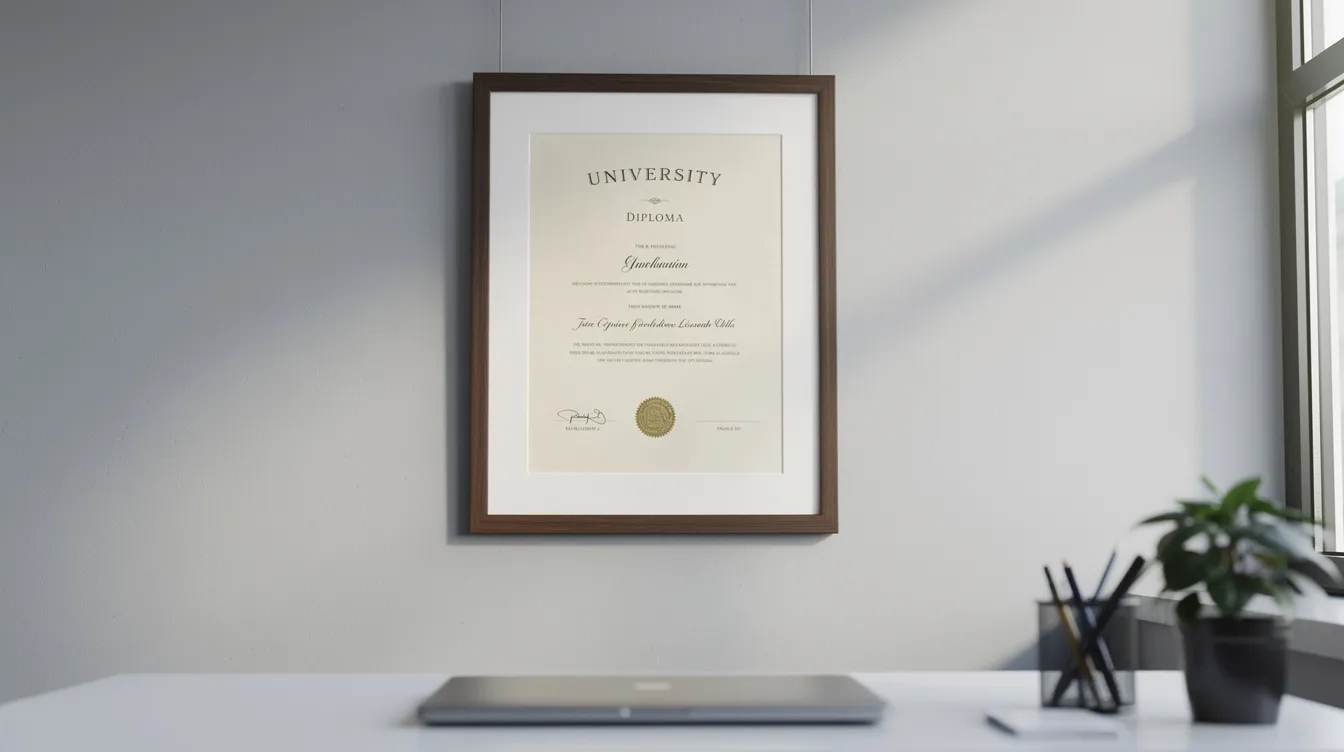
Same Day Diplomas is a U.S.-based e-commerce provider specializing in realistic associate degree replicas available online and other custom replica and replacement diplomas, degrees, transcripts, and certificates. Customers who have earned an AA degree sometimes want an additional high-quality document for personal display, as a commemorative keepsake, or as a film or theatre prop.
Same Day Diplomas can design a realistic replacement AA diploma or transcript inspired by real layouts, fonts, and seals, customized with the customer’s name, major, and graduation date.
Service benefits include:
-
Same-day or 1–2 business-day production
-
Free digital proofs for approval
-
Secure checkout and discreet packaging
-
Worldwide shipping
-
Carbon-neutral printing
Important disclaimer: All Same Day Diplomas products are strictly for novelty, display, and entertainment purposes. They are not official academic credentials and cannot be used for enrollment, licensing, immigration, or employment verification. Authentic credentials come only from accredited institutions.
Those who mislaid an original document or want a display-ready version for home or office can browse AA-style templates, explore USA college and university diploma replicas, and request a custom quote.
FAQ
Do I need a high school diploma to start an Associate of Arts degree?
Most accredited U.S. institutions require a high school diploma or equivalent (such as a GED) for admission to an aa program. Some community colleges offer “ability to benefit” pathways or dual-enrollment for high school students, but these are governed by state and institutional rules. Proof of completion is also typically needed for financial aid eligibility.
Can I complete an AA degree entirely online?
Many regionally accredited community colleges and universities now offer fully online Associate of Arts programs. Online AA degrees still require about 60 credits and include the same general education outcomes as on-campus versions, including courses in creative writing, music, and the humanities. Verify accreditation and transfer agreements before enrolling in an online-only college.
How long can I wait between finishing my AA and starting a bachelor’s degree?
There is usually no absolute time limit on using an AA for admissions purposes. However, individual universities may have “stale credit” policies for certain subject areas like technology, nursing, or rapidly evolving science fields. Liberal arts and general education courses often remain transferable for many years, though requirements can change over time. Students taking a long break should consult advisors at their target university to confirm how existing AA credits apply.
Is an AA enough education for a long-term career, or will I need a bachelor’s degree later?
Many people build solid careers with an AA plus work experience, particularly in administrative, technical support, and public service roles. Other fields—teaching K–12, engineering, accounting, many corporate positions—typically expect a bachelor’s degree as a minimum. Research your target occupations using official sources such as the U.S. Bureau of Labor Statistics Occupational Outlook Handbook to see typical education requirements before deciding whether to pursue additional years of study.
Can Same Day Diplomas provide an official Associate of Arts degree?
Same Day Diplomas cannot grant or verify any real academic degree, including an AA. The company creates high-quality replica and novelty documents for display, props, or personal mementos based on customer requests. These products are not recognized by colleges, licensing boards, employers, or government agencies and must not be used for any official or fraudulent purpose. For official credentials, you must complete coursework at an accredited institution.
